

Herts Cabinet backed SEND units for 36 pupils at Hitchin Boys' and 12 at St Mary's Infants', Baldock, for the 2027/28 school year. Checked November 2026.
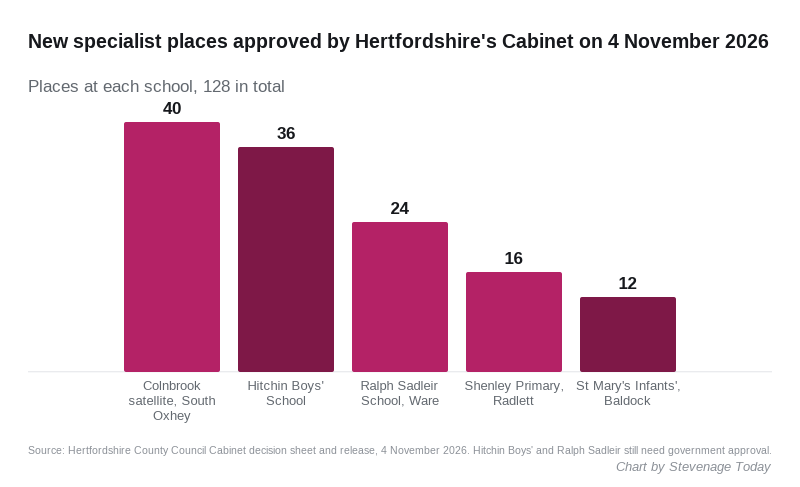
Hitchin Boys’ School and St Mary’s Infants’ School in Baldock are set to gain 48 specialist places for children with special educational needs and disabilities (SEND). Hertfordshire County Council’s Cabinet backed the plans on Wednesday, as part of 128 new places across the county.
None of the five schemes is in Stevenage. The nearest are Hitchin Boys’, about five miles north west of the town with 36 places, and St Mary’s Infants’, about six miles north with 12.
All five are due to open during the 2027/28 school year, according to the Cabinet’s decision sheet. Councillors have until 5pm on 11 November to call the decisions in for review.
Where the places will be
The council approved more than £7m for four SEND units inside mainstream schools, giving 88 places. The decision sheet puts the figure at £7.107m.
- Hitchin Boys’ School, Hitchin: 36 places
- Ralph Sadleir School, Ware: 24 places, about ten miles south east of Stevenage
- Shenley Primary School, Radlett: 16 places, about 14 miles south
- St Mary’s Infants’ School, Baldock: 12 places
Cabinet also approved a satellite of Colnbrook Special School at Woodhall Primary School. Both are in South Oxhey, about 20 miles south west of Stevenage. It gives 40 places for children and young people with severe learning difficulties, at a cost of £3.712m.
At Ralph Sadleir, the report says a new modular building would re-provide space for eight pupils with SEND needs and create 16 new places. It adds that this may change as feasibility work finishes.
The cost of each unit has not been published. The Cabinet report holds that breakdown in its private section and says the final costs still depend on further design and survey work.
Hitchin Boys’ still needs government approval
The council’s announcement says the proposals were approved, but for Hitchin Boys’ and Ralph Sadleir that is not the last word. Both are academies. They run their own consultations and send a business case to the Secretary of State, who makes the final decision.
The Cabinet report says the two schools will seek that approval this autumn term. In the council’s experience, such applications tend to be considered three to four months after they go in. What Cabinet agreed for those schools is the money.
Hitchin Boys’ would carry out its own building work, under a funding agreement with the council. The plan turns the school’s Year 12 sixth form block into the unit, with permanent replacement sixth form accommodation to follow.
In the meantime, sixth formers would use the “soon to be vacant” Bancroft building. The report says the council had earmarked the youth centre space at the front of that building for sale. Holding on to it would delay a receipt of about £750,000 by 24 to 36 months.
The report rates the risk that the temporary sixth form space is not ready in time as medium likelihood and high impact. It gives the same rating to planning delays and rising costs.
What Baldock parents were told
St Mary’s Infants’ takes children from Reception to Year 2, aged four to seven. Its unit will use two classroom spaces and the adjoining toilets, storage and group rooms, none of which the school uses at present. These will be refurbished, with access to fenced outdoor space where appropriate.
The building has room for 180 pupils and has 82 on roll, the report says. The council recently cut the school’s yearly intake from 60 to 30.
The council sent 96 copies of the consultation letter to parents and carers at the school, and 12 people responded. Ten agreed and two disagreed. One comment raised traffic, parking and road safety. The council replied that a unit for 12 children is not expected to have a significant effect, and that no extra parking is planned.
The council says it intends to finish the work by September 2027 at the latest, and will pay the full building cost.
Why the council is doing it
Councillor Mark Watkin, Executive Member for Education, SEND and Inclusion, said: “Every child deserves to feel included, supported, and able to thrive in education close to their home. We’re building a more flexible system, so children get the right support, at the right time, in the right setting.
“SEND Units are an important part of that approach, providing specialist support within mainstream schools, while our plans for Colnbrook’s satellite provision will increase capacity for children and young people whose needs require a higher level of specialist support.”
The council says children in a unit get most of their education there, in an adapted setting, and join mainstream lessons, activities and school events where appropriate.
Mrs Melidoro, headteacher of Morgans Primary School in Hertford, whose SEND unit has just opened, said of the children who joined this term: “The children have settled in beautifully. They are part of our Sycamore and Willow classes and every child wanted to welcome them into their cohort. They are part of lunchtimes, playtimes and, in some cases, lessons such as PE and Music. The children have forged friendships in their cohort; they are part of our Morgans family.”
There is a financial case too. The report says an independent placement costs on average £40,000 more than a place in a unit. It also expects school transport costs to fall as pupils are placed closer to home.
The schemes are part of the SEND Provision Plan, which the council says will create 1,150 specialist places by 2029, at least 650 of them in units and similar provisions in mainstream schools. The budget has since risen from £140m to £147.343m, and £100.106m is left after this round.
What it means for you
These are not places you apply for through school admissions. For the Baldock unit, the consultation letter says:
- a child must have an Education, Health and Care Plan (EHCP), with identified Cognition and Learning and co-existing needs
- the county council places children in the unit and names the school in the child’s EHCP
- admission is separate from the school’s general admissions process
The council’s report describes the Hitchin Boys’, Ware and Radlett units as serving the same group of needs. The council’s Local Offer site explains who to contact about a child’s EHCP.
The report says further units are being developed but does not name them, so no Stevenage scheme has been announced. The town’s The Valley School was rebuilt for £15.8m and opened its new building to more than 175 students in January 2024.
The plan’s team can be reached at SENDStrategy@hertfordshire.gov.uk.
Also at the same meeting
Cabinet agreed to start pre-consultation on merging Purwell Primary School and Mary Exton Primary School in Hitchin into one new primary from 1 September 2027. The report says the two schools have 206 pupils between them and 420 places. Pre-consultation is due to run from 12 November to 10 December.
See also: Stevenage primary school places for 2027 and Hertfordshire school term dates.
Have your say