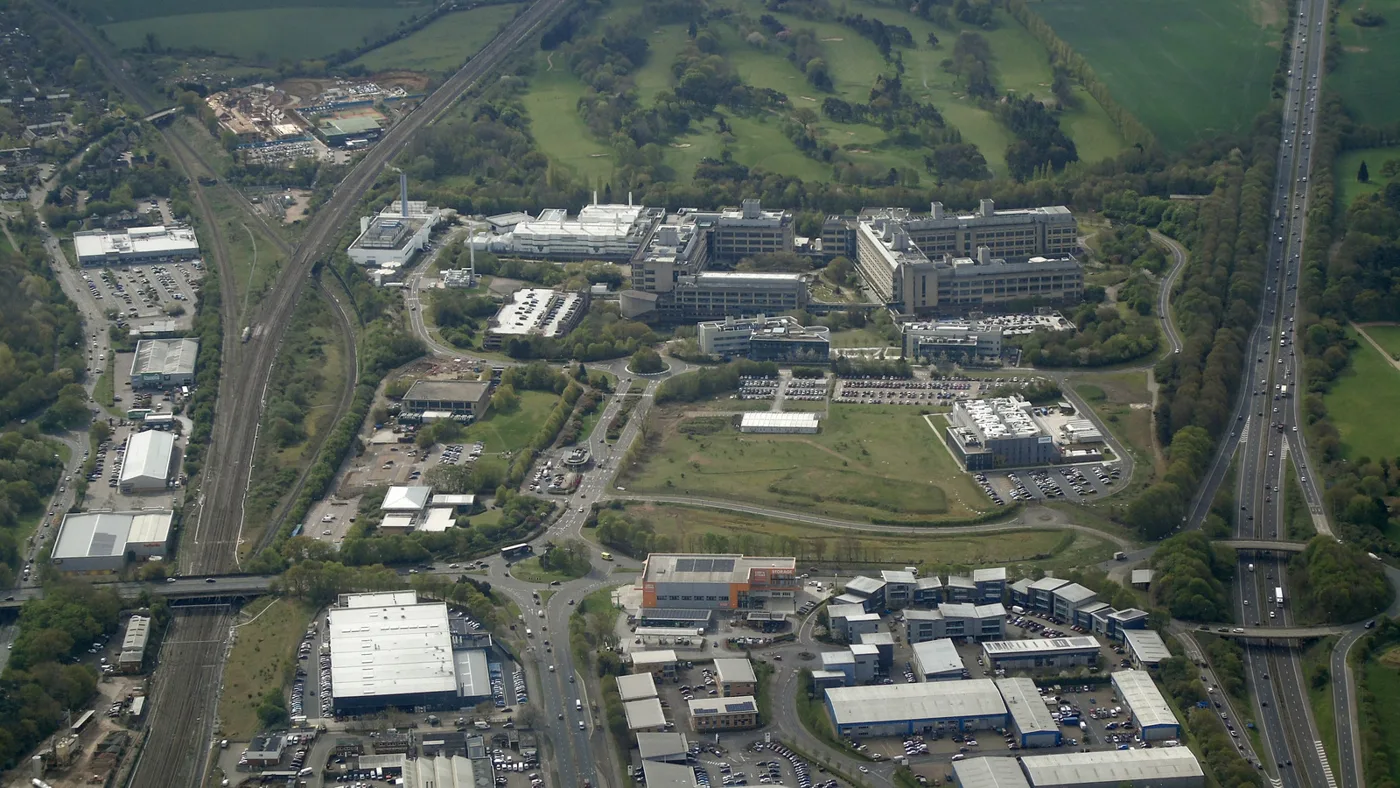

GSK will vacate its Stevenage research site by 2029, moving scientists to a new £400m Cambridge centre and to Ware. Its notice gives no job figure for the town.
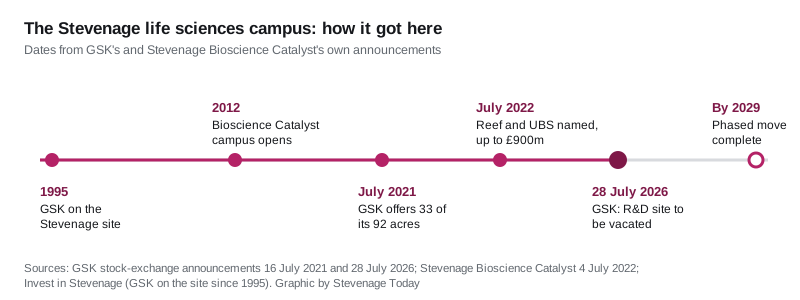
GSK is leaving the research site it has run in Stevenage for three decades. In a stock-exchange announcement issued on 28 July, the company said that as a result of a planned move to Cambridge it “will vacate its R&D site at Stevenage, Hertfordshire, with a phased move for employees by 2029”. (GSK, 28 July 2026)
Three weeks on, GSK has published no further detail about the Stevenage site. What follows is what the company’s own notice says, what it does not say, and what is staying put on the campus next door.
What GSK’s announcement says
A stock-exchange announcement is a short, precise document. On Stevenage and Hertfordshire, this one says the following:
- GSK will vacate its R&D site at Stevenage, “with a phased move for employees by 2029”.
- The move is a consequence of establishing a new flagship R&D centre in Cambridge.
- GSK will also “upgrade its existing R&D laboratories at Ware in Hertfordshire and move some employees there”, creating “a fully integrated drug development and commercial manufacturing scale up capability”.
- The company “plans to invest £400 million over 3 years in support of these changes”.
- GSK’s global headquarters in London is “unaffected by today’s announcement”.
The new site is 300,000 square feet on the Cambridge Biomedical Campus, currently being developed by Prologis. GSK says it will be home to “more than 1,000 GSK scientists” working in oncology, respiratory, hepatology, vaccines and HIV. The company adds that it invests over £6 billion in R&D each year, of which more than £1.5 billion is in the UK. (GSK press release, PDF)
What it does not say
The notice carries no headcount for Stevenage at all. It does not say:
- how many people work at the Stevenage site now;
- how many will be offered a move to Cambridge or to Ware;
- how many roles, if any, will go;
- when the first phase of the move starts, only that it finishes by 2029;
- what happens to the buildings and land GSK vacates.
Staff numbers for the site have been widely quoted elsewhere. None of those figures appear in GSK’s own announcement or on its website, so we are not repeating them here. If GSK publishes a Stevenage figure, we will report it.
Why now: a £1.9bn savings programme
The Stevenage line sat inside a much larger set of announcements made the same morning, when GSK published its second-quarter results.
The company set out a three-year restructuring programme it calls Accelerate Growth. It targets £1.9 billion of annual savings, fully realised by 2029, at an expected total cost of £2.4 billion, of which £2.1 billion is cash. Most of those costs fall in 2026 and 2027. GSK says the savings will be “primarily reinvested in R&D”. (GSK Q2 2026 results, PDF)
On how the savings are found, GSK’s wording is worth reading in full. They are “expected to be enabled by technology and AI and generated by streamlining support services and process redesign including procurement delivery, the reallocation of resources to Specialty Medicines from established products and further simplification of supply chain and the site network to align with portfolio evolution”.
That last phrase, simplification of the site network, is the category Stevenage falls into.
What stays in Stevenage
The GSK laboratories are one part of the campus, not the whole of it. Stevenage Bioscience Catalyst, which sits alongside them, is a separate, independent not-for-profit organisation, and it is staying.
SBC put out its own statement the morning after the GSK announcement. It says the campus is now home to more than 45 businesses working in cell and gene therapy, AI-enabled drug discovery, neuroscience, diagnostics and precision medicine. (Stevenage Bioscience Catalyst, 29 July 2026)
Professor Jackie Hunter, chair of the SBC board, said: “Since it was created in 2012 the Stevenage Bioscience Catalyst has created a strong ecosystem where companies based here have raised more than £4 billion in investment over the past decade. With more than 45 pioneering companies on campus, we have great confidence in the future of the cluster and will continue to support our collaborative community here.”
Andrew Waters, SBC’s chief executive, was more direct about the human side. “Our thoughts are with everyone affected by GSK’s announcement, and we recognise this will be an uncertain time for many colleagues and their families,” he said. “Our focus remains on supporting the outstanding companies based here in Stevenage and helping them start, grow and succeed.”
Councillor Richard Henry, leader of Stevenage Borough Council, said in the same statement: “Stevenage has built a thriving life sciences ecosystem and remains a key location for innovation, investment and high-value employment. As the town continues its £1 billion regeneration programme, we look forward to continuing our close partnership with Stevenage Bioscience Catalyst, businesses and academic partners to strengthen Stevenage’s position at the heart of the UK’s life sciences Golden Triangle.”
The Cell and Gene Therapy Catapult’s manufacturing centre is also on the campus. The council describes Stevenage as the UK’s largest cell and gene therapy cluster and the third largest in the world, and says the town has been home to GSK since 1995. (Invest in Stevenage, Stevenage Borough Council)
The 2021 plan, five years on
The announcement lands on a campus that was in the middle of the biggest expansion in its history, and GSK started that expansion itself.
- 16 July 2021. GSK announced it would sell 33 acres of its 92-acre Stevenage R&D site to a development partner, aiming to unlock “up to £400 million in new investment” and “potentially create up to 5,000 highly-skilled jobs, over the next five to ten years”. (GSK, 16 July 2021)
- 4 July 2022. Reef Group and UBS Asset Management were named as the development partners, expected to deliver “up to £900m of new investment alongside an estimated 1.4 million square feet of laboratory and office facilities, providing space for up to 5,000 new jobs”. GSK also agreed to gift land on the new campus to SBC so it could expand. (Stevenage Bioscience Catalyst, 4 July 2022)
Read the 2021 announcement again and the shift is plain. GSK said then that the new cluster “would build on the existing presence of GSK, the Cell and Gene Therapy Catapult and the SBC on the site”. One of those three is now leaving.
What it means for you
- If you work at the site. The only published timetable is GSK’s own: a phased move for employees completing by 2029. Nothing in the announcement takes effect this year. Any consultation on individual roles would come through GSK, not the council.
- If you work elsewhere on the campus. SBC, its 45-plus companies, the Cell and Gene Therapy Catapult and the new campus buildings are separately run and are not covered by the announcement.
- If you are weighing up a move to Stevenage. This is a 2029 change to one employer, not an immediate one. Our Stevenage house prices page tracks what the market is actually doing, from Land Registry data rather than agents’ estimates.
- If a move to Cambridge or Ware would affect your commute. Both are reachable by train from Stevenage; our Stevenage train times page covers the station and its operators, and Stevenage roadworks and travel covers the A1(M) and current closures.
- If you want to follow what happens to the land. Any redevelopment of the GSK site would need permission from Stevenage Borough Council. We list new applications weekly on our Stevenage planning news page.
Sources
- GSK to establish new flagship R&D centre on Cambridge Biomedical Campus, UK, GSK stock-exchange announcement, 28 July 2026
- GSK Q2 2026 results announcement, 28 July 2026 (Accelerate Growth programme, page 3)
- Statement from Stevenage Bioscience Catalyst on GSK’s continued investment in UK life sciences, 29 July 2026
- GSK unveils plan for one of Europe’s largest life science campuses in Stevenage, 16 July 2021
- Stevenage Bioscience Catalyst: developer named for campus expansion, 4 July 2022
- Healthcare and life sciences, Invest in Stevenage, Stevenage Borough Council
Have your say