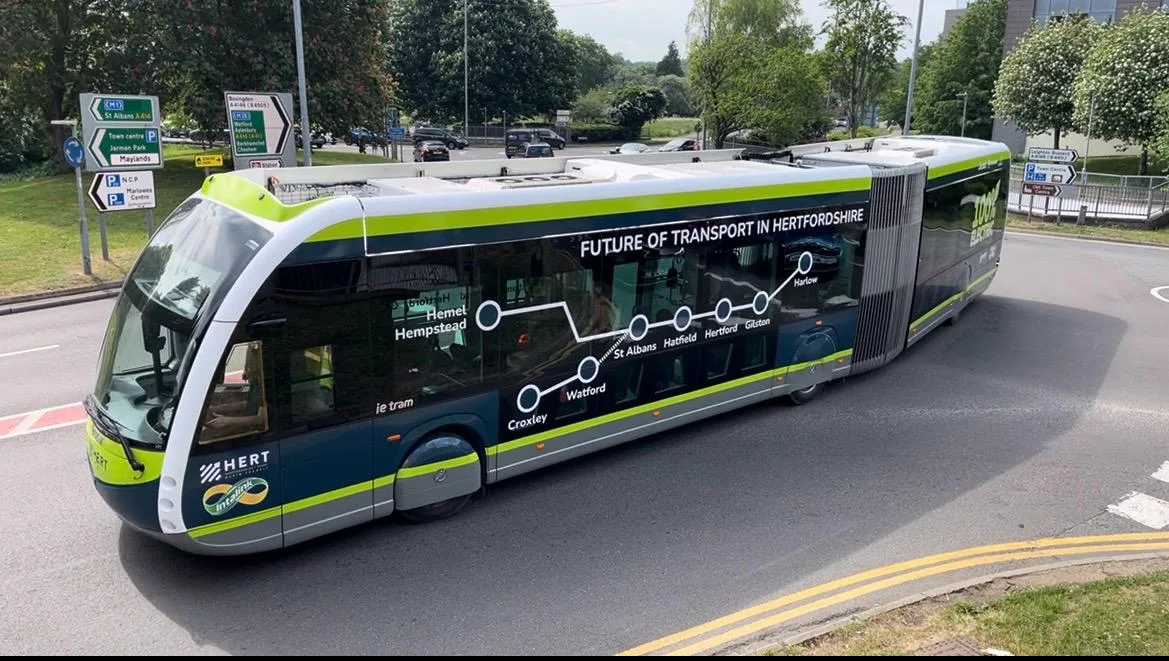

Hertfordshire's HERT trackless tram route from Hemel to Harlow is out for consultation to 4 December. Stevenage is not on it; Hatfield and Hertford hubs link.
Hertfordshire County Council has opened a public consultation on its plan for trackless trams running east to west across the county, and residents have until 4 December 2026 to respond. The council launched the survey on 23 October on its Let’s Talk Transport site.
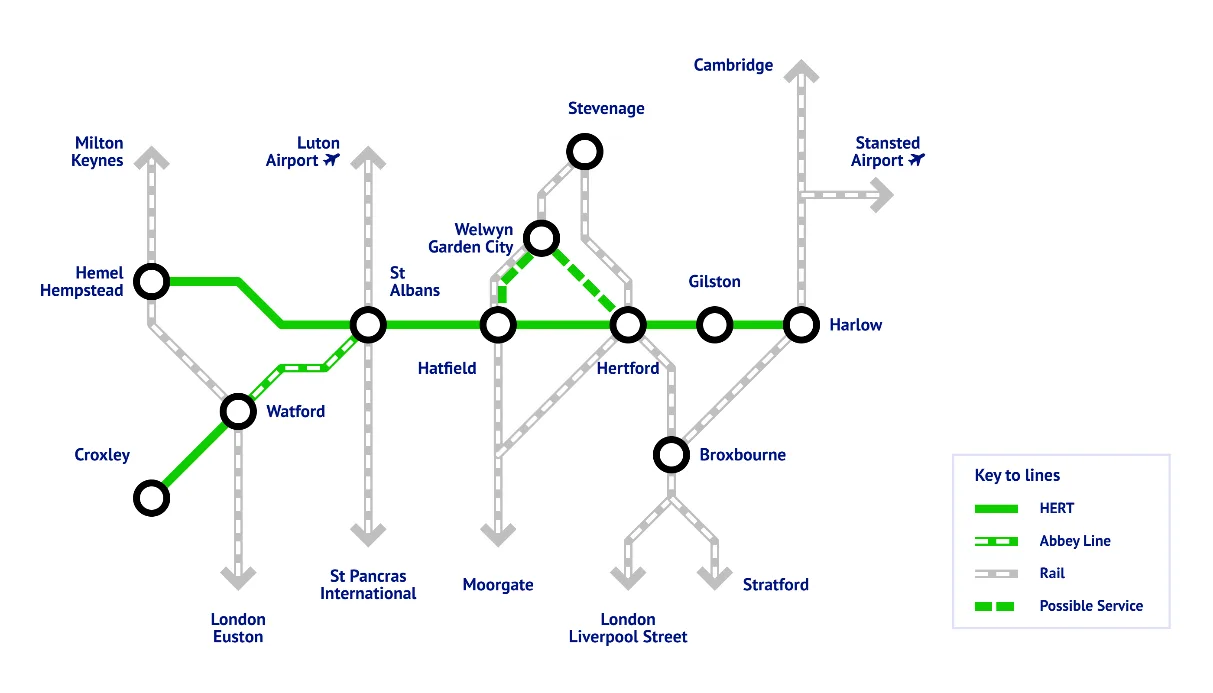
The scheme is the Hertfordshire Essex Rapid Transit, or HERT. The draft HERT Strategy sets out a 67km corridor from Hemel Hempstead and Croxley, west of Watford, to Harlow in Essex, through St Albans, Hatfield, Hertford and the new Gilston Garden Town. It names a preferred route, the locations of proposed hubs, and trackless trams as the preferred vehicle.
Stevenage is not on the route. The nearest planned hubs are at Hatfield railway station and in Hertford, and the strategy describes both as interchanges with lines that serve Stevenage.
What the council is proposing
The trams would be fully electric, carry up to 140 passengers and run on existing roads rather than rails, with bus priority and dedicated lanes where the council can provide them. The strategy says they would run every 10 minutes and are forecast to be 90% full at peak times along parts of the route.
According to the council’s executive summary, more than 900,000 people live within the HERT corridor and about 350,000 live within one kilometre of the proposed route. Transport modelling, it says, shows some public transport journeys becoming “up to 70% faster than today”. The strategy links the scheme to 50,000 new homes and 50,000 jobs and connects it to five national rail stations.
The council says trackless trams were chosen “due to its flexibility, low cost and reduced delivery risk”, and the strategy argues the system “offers the benefits of light rail at a fraction of the cost”. Neither document published with the consultation gives a total cost for the scheme.
Where Stevenage fits
The draft strategy plans three HERT hubs in Hatfield. One of them, at Hatfield railway station, “provides rail connection via the East Coast Main Line to Welwyn Garden City, Stevenage, Moorgate, Kings Cross and Cambridge”. In Hertford, the West Hertford hub would sit near Hertford North station, “providing connections to Moorgate and Stevenage”.
The strategy also floats a “complementary service” through Welwyn Garden City as “a future evolution” of the network, running via the A1000, the A6129, Osbourn Way and Black Fan Road. It is shown as a possible service, not part of the preferred route.
For a Stevenage resident, that means HERT would be reached by train, changing at Hatfield or Hertford North, rather than from the town itself.
What the council says
Cllr Paul Zukowskyj, the county council’s Executive Member for Environment, Transport and Growth, said:
“Hertfordshire is growing, and we need a plan to ensure people can get where they need to be.
“HERT is about taking a practical, evidence-led approach to improving east-west travel, offering cleaner, more reliable and more attractive alternatives to the car. By developing the programme in phases, we can deliver improvements quickly while planning responsibly for the future.”
The council says the feedback will “help inform the next stage of developing the HERT programme”.
When it could happen
The council’s HERT page gives this timetable:
- 2026 to 2027: consultation on the draft strategy, then a final HERT Strategy
- 2027 to 2035: “building blocks” in Hatfield, Hemel Hempstead, St Albans and Hertford
- 2035 to 2040: fully operational
The council says earlier work, including bus priority measures, mobility hubs, walking and cycling links and better travel technology, would benefit existing bus services “well before the full trackless tram network is introduced”.
What people said last time
This is not the first round. In a 2021 engagement, the council says 75% of respondents supported or strongly supported the HERT vision, 73% put reliable journey times first, 71% chose service frequency, and 68% said they would be likely to use it.
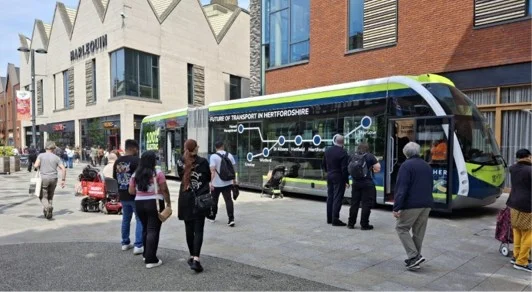
In May 2026 the council held six “Future of Transport in Hertfordshire” events where it showed an example HERT vehicle. Its summary of that feedback records general support for the idea and a “desire for faster delivery and trials”, alongside concern about unreliable buses, infrequent timetables and anti-social behaviour, and about “the lack of dedicated track and bus priority, route feasibility and long delivery timeline”.
What it means for you
If you travel east or west across the county, to Hatfield, St Albans, Hertford or Harlow, this is the stage where the route, the hub locations and the choice of vehicle can still change. The survey asks about all three and ends with space for your own comments. It closes on 4 December 2026.
Questions can go to the project team at HERT@hertfordshire.gov.uk. For getting around Stevenage now, see our roadworks and travel page and train times to London.
Have your say